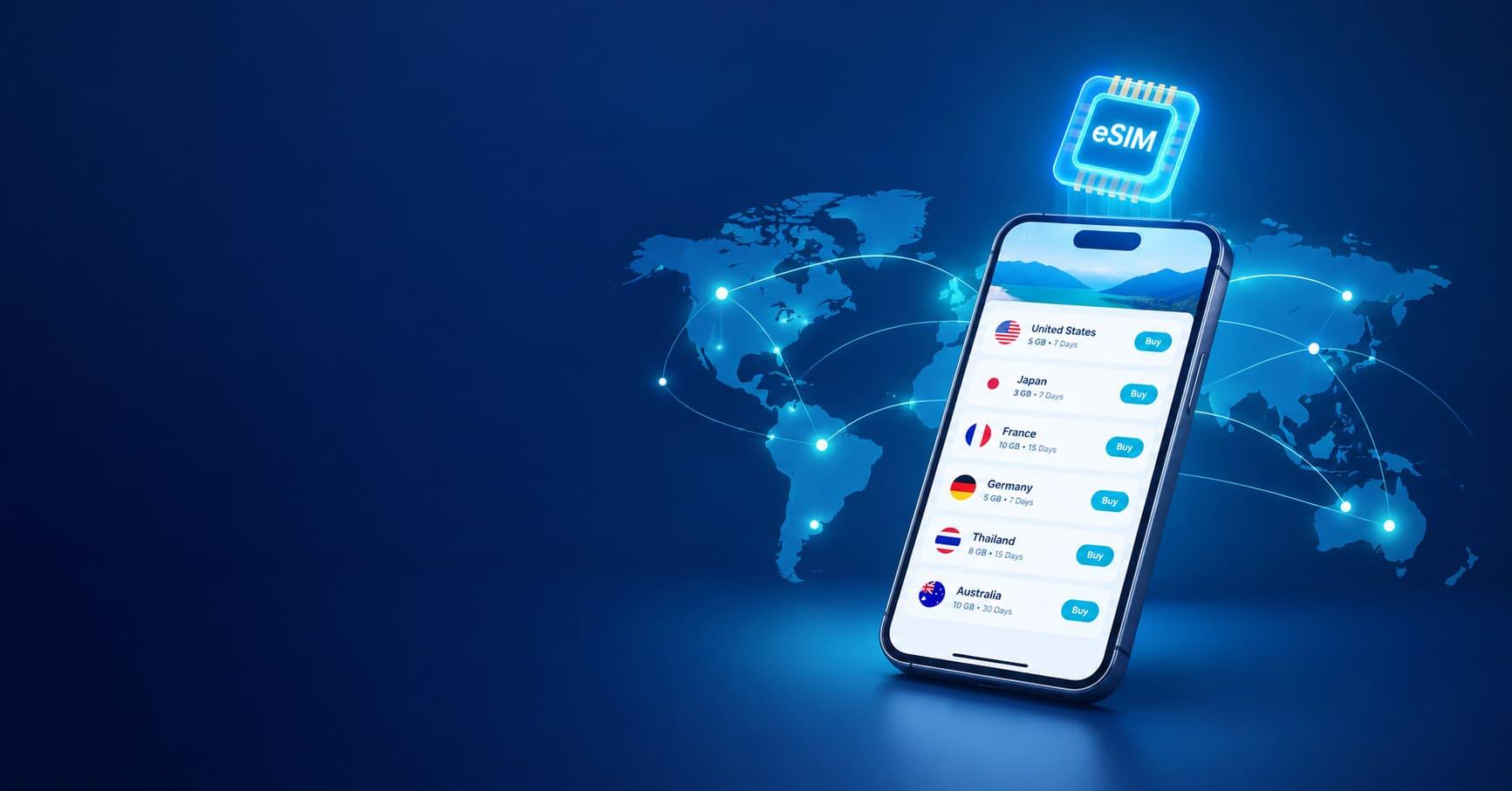
Travellers no longer queue at airport kiosks for a local SIM card. They open an app, pick a data plan, and are online before the plane reaches the gate. Apps like Airalo and Nomad made this normal, and they proved that selling mobile data is a business anyone with an audience can run.
You do not need to be a telecom operator to enter this market. With the right eSIM app development partner, you can launch your own branded app and website, connect to existing eSIM suppliers, and start selling data plans worldwide.
This guide explains how eSIM app development works, what features you need, how long it takes, and how to choose between white-label and building from scratch.
What is an eSIM app?
An eSIM app lets users buy and activate a mobile data plan digitally, with no physical SIM card. The eSIM is a chip already built into most modern phones. The app sends a carrier profile to that chip over the internet, a process called remote SIM provisioning.
For the user, the flow takes a few minutes:
- Choose a country or region and a data plan.
- Pay inside the app or on the website.
- Install the eSIM with one tap or a QR code.
- Connect to a local network on arrival.
Behind the scenes, the app talks to eSIM suppliers through their APIs. The supplier provides the network access. Your app provides the brand, the storefront, and the customer experience.
How an eSIM business makes money
The model is simple: buy data plans at wholesale rates from suppliers, and sell them at your own retail price.
- You set the price. You choose which plans to list and what to charge, straight from your admin panel.
- Margins are healthy. Depending on the plan and supplier, wholesale rates typically leave room for margins of roughly 20% to 50% or more.
- No inventory. Plans are digital and issued on demand, so there is no stock to hold or ship.
- Repeat customers. Travellers come back for top-ups and for their next trip.
This is why travel agencies, travel creators, telecom resellers, fintech apps and affiliate marketers are launching their own eSIM brands. If you already earn commission promoting someone else’s eSIM app, owning the app means keeping the full margin and the customer relationship.
Must-have features of an eSIM app
A complete eSIM platform has three parts: the customer apps, the website, and the admin panel that runs the business. All three should share one backend.
Customer app (Android and iOS)
- Plan browsing by country, region and global coverage
- Clear plan details: data amount, validity, price and supported networks
- Secure checkout with multiple payment gateways
- One-tap or QR code eSIM installation
- Live data usage and validity tracking
- Top-ups and plan renewals
- Order history and account management
- Device compatibility check before purchase
eSIM website and storefront
Many customers buy on a laptop before they travel, so the website matters as much as the app. It needs the same catalogue, the same checkout, and fast, mobile-friendly pages that can rank on Google for searches like “eSIM for Thailand”.
Admin panel
The admin panel is where you make money. It should let you:
- Choose which plans to sell and set retail prices
- Manage users, orders, subscriptions and billing
- Track sales and usage with real-time analytics
- Control staff access with secure roles
- Customise branding and content
Multi-provider integration
Relying on one supplier is a risk. A well-built eSIM app connects to several providers, such as Airalo, Nomad and others, so you can offer wider coverage, compare wholesale rates, and keep selling if one supplier has an outage.
Security
eSIM apps handle payments and personal data. Look for GSMA-compliant provisioning, encryption, API security layers and multi-level authentication as standard, not as extras.
White-label eSIM app vs building from scratch
For most businesses, white-label eSIM app development is the better choice. You get a proven framework, customised to your brand and business model, without paying to reinvent what already works.
| White-label eSIM app | Built from scratch | |
|---|---|---|
| Time to launch | Weeks | Many months |
| Cost | Lower, since the core is already built | Higher, since everything is new |
| Risk | Lower, the framework is already tested | Higher, more unknowns |
| Branding | Fully your own brand | Fully your own brand |
| Customisation | Built around your business model | Unlimited |
| Best for | Launching fast and validating the market | Unusual products with unique requirements |
Build from scratch only if your product does something no existing eSIM platform does. Otherwise, launch with white-label and invest the savings in marketing.
How eSIM app development works, step by step
- Plan and prototype. Define your goals, target markets and business model. Map the user journey and design the interface for Android, iOS and web.
- Set up supplier accounts. Sign commercial agreements with one or more eSIM providers and get API access. Your development partner can recommend and introduce suppliers.
- Develop and integrate. Build the apps, website and admin panel on a shared backend. Integrate supplier APIs, payment gateways and automated eSIM activation.
- Test. Check performance, security, compliance and real-device eSIM installation across supported phones.
- Launch. Submit to the App Store and Google Play, publish the website, and start selling.
- Support and improve. Monitor the platform, fix issues, and add plans, providers and features as you grow.
How long does eSIM app development take?
A white-label eSIM platform, including Android and iOS apps, a website and an admin panel, typically takes 5 to 6 weeks to deliver. The exact timeline depends on three things:
- Scope. Extra features and custom designs add time.
- Supplier access. Development moves faster once your supplier API accounts are ready.
- App store approval. Apple and Google review times are outside anyone’s control.
What affects the cost of an eSIM app?
There is no single price, because cost follows scope. The main factors are:
- Platforms: website only, apps only, or the full set
- Number of eSIM providers to integrate
- Payment gateways and currencies
- Level of custom design and features beyond the standard framework
- Languages and regional requirements
- Post-launch support and maintenance
Ask for a fixed quote against a clear scope, and check what is included after launch.
How to choose an eSIM app development company
Not every app agency understands eSIM. Before you sign, ask these questions:
- Have you built an eSIM platform before? Proven eSIM experience means your project is not their learning exercise.
- Which providers can you integrate? Look for multi-provider experience, not a single API.
- Do you build the full stack? Website, apps and admin panel from one team avoids integration gaps.
- How do you handle security and compliance? Expect clear answers on GSMA standards, encryption and authentication.
- What happens after launch? Ongoing support, updates and maintenance should be on the table.
At MiraiLit, we have built and shipped eSIM websites and apps with multi-provider integration. Our eSIM app development service covers the customer website, native Android and iOS apps, and a full admin panel.
Frequently asked questions
Can I launch my own branded eSIM app?
Yes. With white-label eSIM app development, you launch a fully branded app for Android and iOS, plus a website, built around your business model.
Do I need to be a telecom company to sell eSIMs?
No. You resell data plans from existing eSIM suppliers through their APIs. You need a supplier agreement, not your own network.
How do eSIM apps connect to carriers?
The app integrates with eSIM provider and aggregator APIs. When a customer buys a plan, the system requests an eSIM profile and delivers it to the phone automatically.
Is a white-label eSIM app better than building from scratch?
For most businesses, yes. White-label development saves months of build time and reduces cost, while still giving you your own brand and pricing.
How secure is an eSIM app?
A properly built eSIM app uses end-to-end encryption, API security layers, GSMA-compliant provisioning and multi-level admin access control.
Do eSIM apps work worldwide?
Yes. Users can activate or switch local data plans while travelling, in any country your suppliers cover.
How much can I earn from an eSIM app?
It depends on your pricing, audience and volume. You set retail prices yourself, and wholesale rates typically leave margins of roughly 20% to 50% or more per plan.
Ready to launch your eSIM app?
The eSIM market rewards brands that move early and own their customers. If you have an audience of travellers, the technology is no longer the hard part.
Tell us about your eSIM business and we will map out the fastest path to launch. Talk to MiraiLit or explore our eSIM app development service.